Navigation
Related
Our shipboard davit for free-fall lifeboats ensure reliable and safe deployment. The hydraulic drive guarantees smooth, rapid launching and subsequent recovery.
The developed solutions are designed for increased capacity and include modifications with gravity wire-rope launching. This ensures an optimal and reliable design tailored to your vessel’s specific requirements.
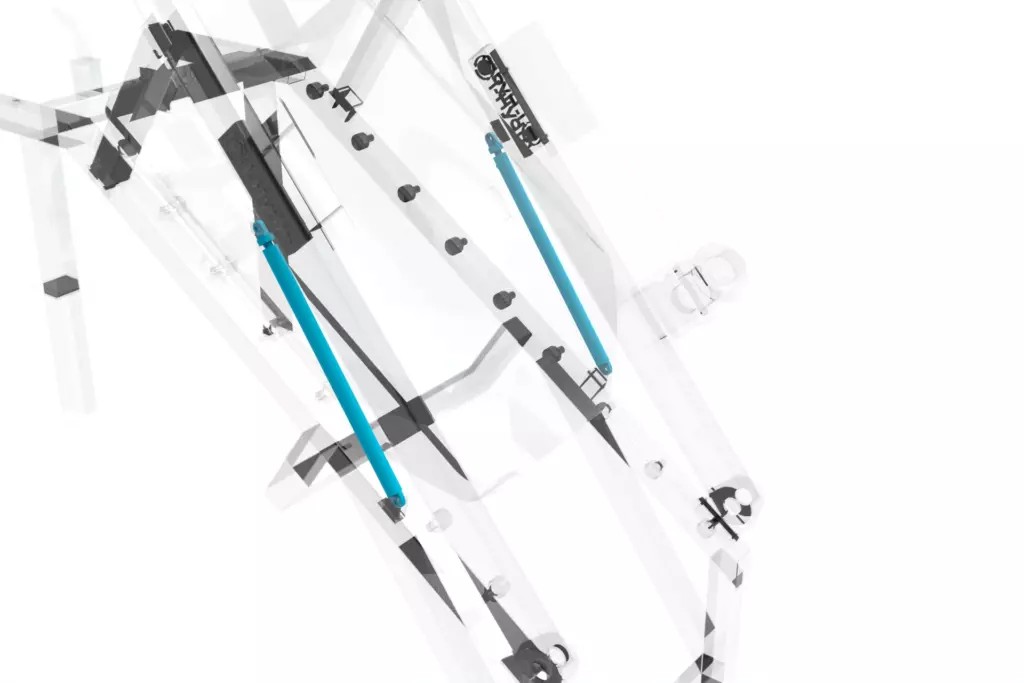
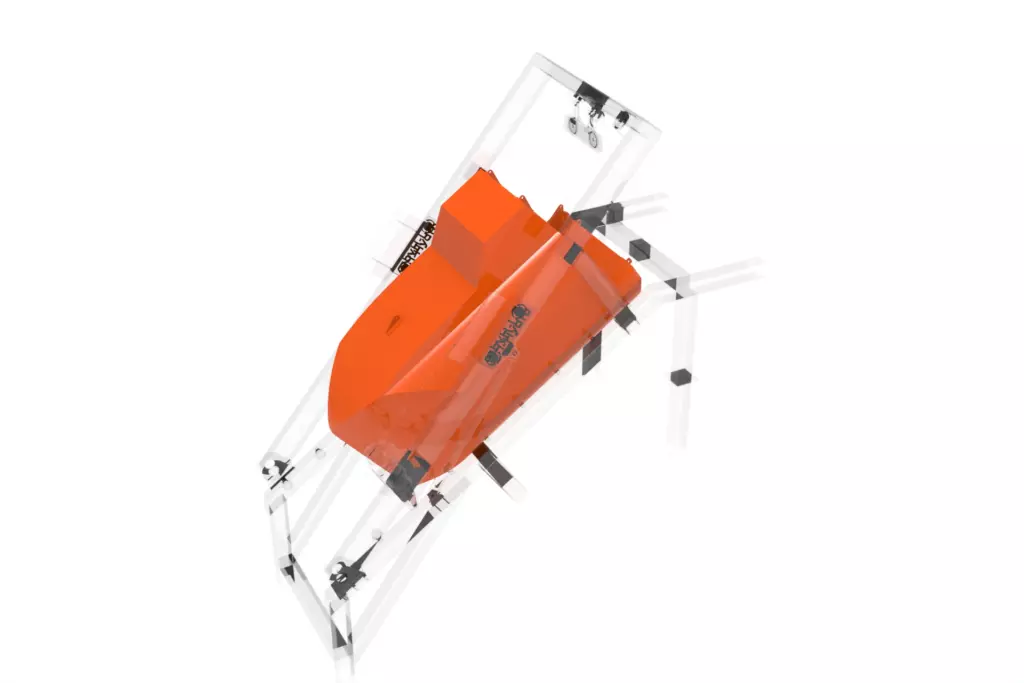
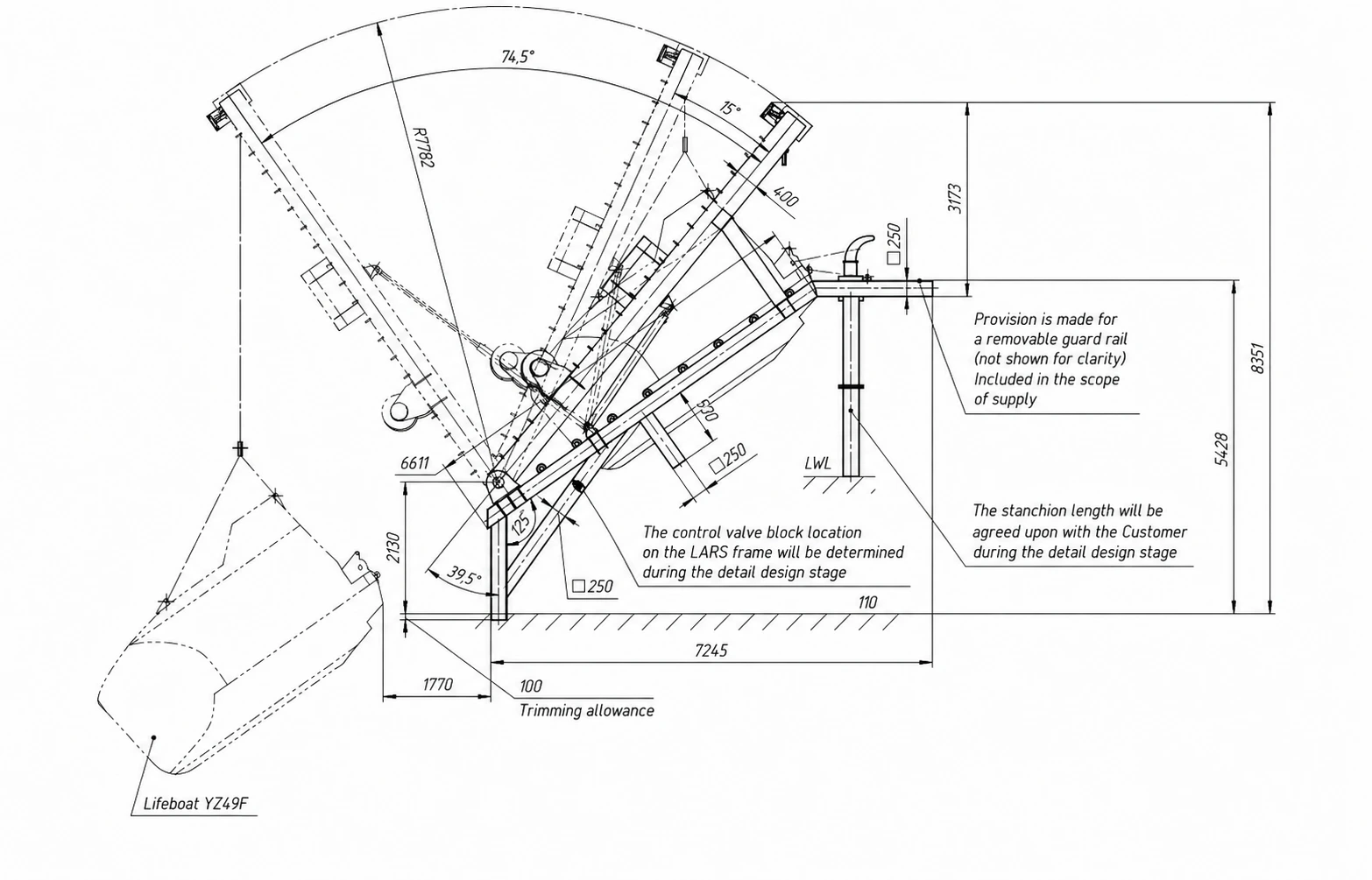
Davit model 55 kN is a shipboard launching and recovery system for the YZ49F free-fall lifeboat. The design, featuring two hydraulic cylinders and a movable arm, ensures reliable recovery of the lifeboat at its full 16-person capacity.
Loading model
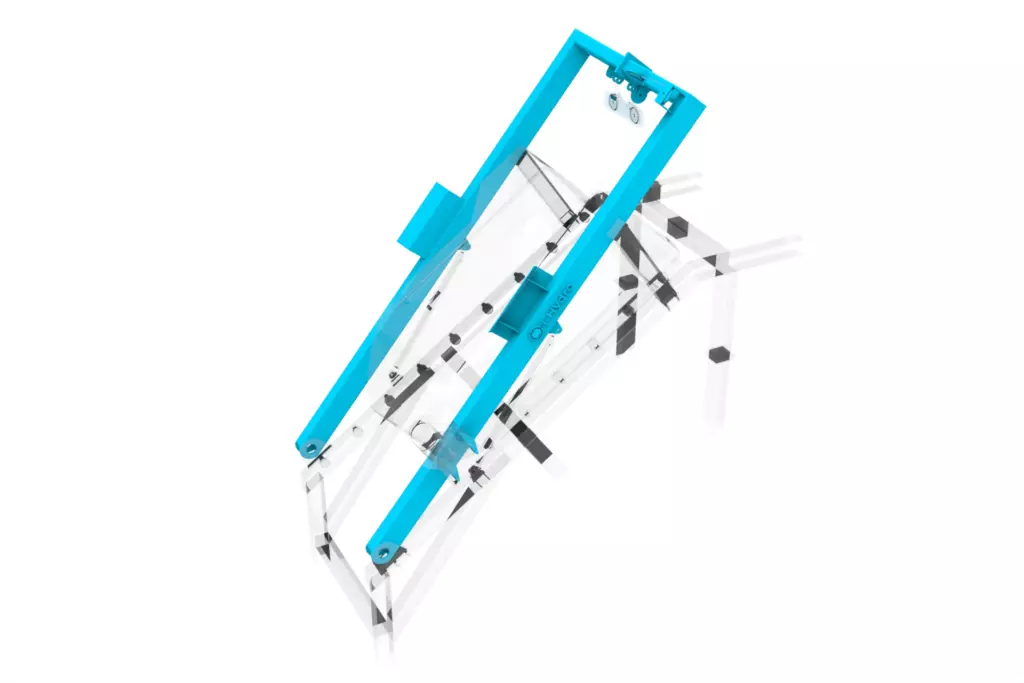
(Highlighted in turquoise)
The boom is a welded metal box-section structure, ensuring high strength and load resistance. A winch with a wire rope system mounted on the boom provides efficient and reliable lifeboat lifting. In the stowed position, the boom is securely locked on supports, preventing any displacement even under lateral impact.
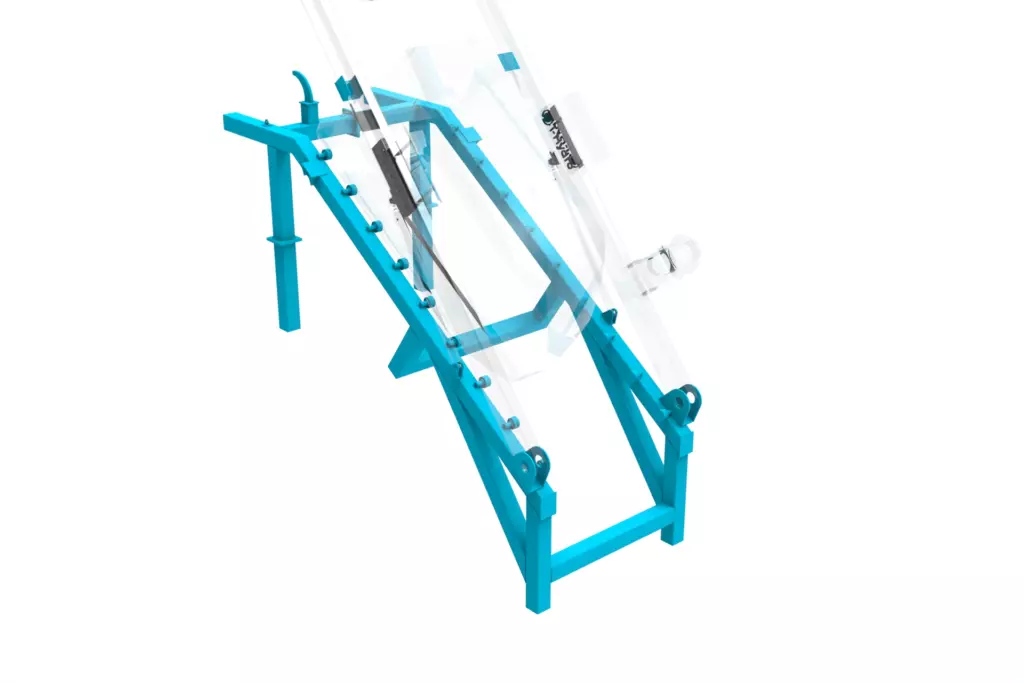
(Highlighted in turquoise)
The frame is a welded metal box-section structure providing high rigidity and system stability. Integrated rollers ensure smooth lifeboat launching, while safety locks manage the security of the process.
The frame is mounted at the deck edge with the necessary inclination, enabling rapid lifeboat launching into the water under its own weight.
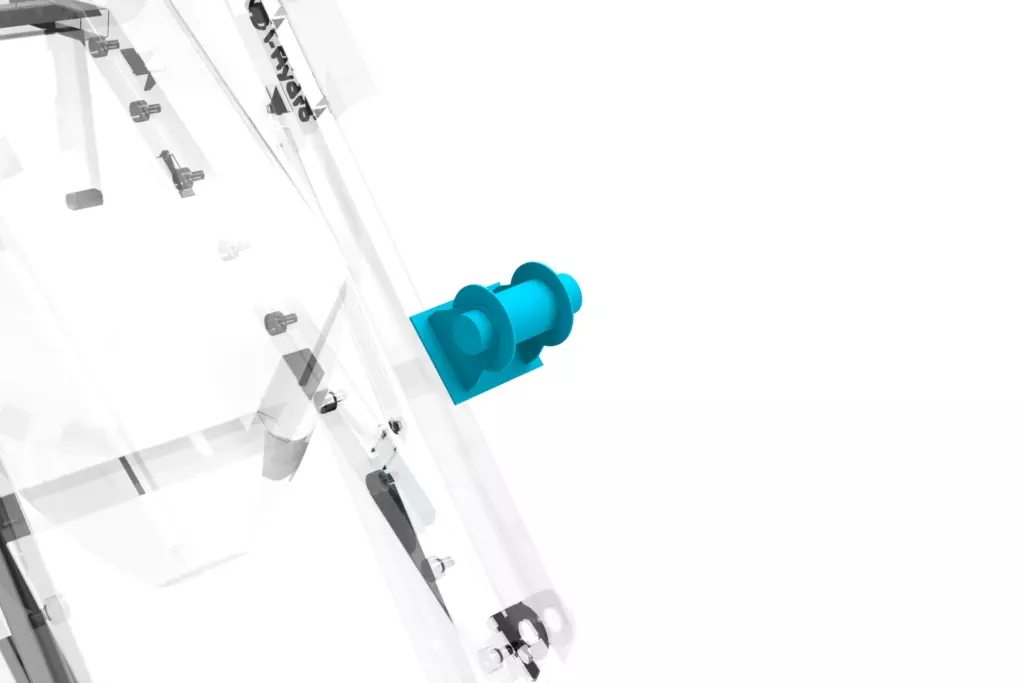
(Highlighted in turquoise)
The winch, mounted on the boom, provides lifeboat recovery via a wire rope system. Its hydraulic drive ensures reliable operation even at full capacity, enabling the lifting of structures weighing up to 4 tons.
(Highlighted in turquoise)
The boom support is a welded metal box-section structure. It provides stability and reliable fixation of the boom in the specified position.
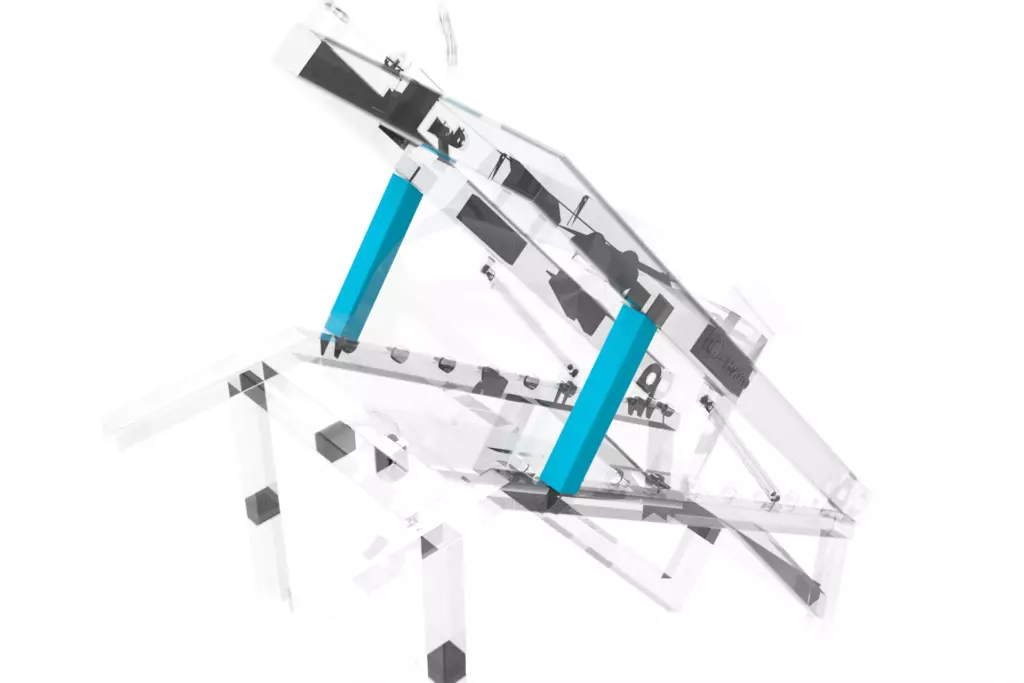
(Highlighted in orange)
A pair of hydraulic cylinders provides smooth and precise control of the boom outreach, ensuring reliable lifeboat recovery.
(Highlighted in orange)
The davit is specifically designed for the YZ49F lifeboat with a mass of 2.5 tons, ensuring reliable launching and recovery for a crew of up to 16 people.
The following documentation provided with the davit::
| Document | Quantity |
|---|---|
| Product Data Sheet | 1 |
| Installation, Commissioning, and Adjustment Manual | 1 |
| Operating Manual | 1 |
| Onboard Test Program and Methodology | 1 |
| Declaration of Materials (DM) | 1 |
| Supplier’s Declaration of Conformity (SDoC) | 1 |
Rescue “Elevator” for Sailors: How a Heavy Lifeboat Leaves a Sinking Ship
When a massive dry cargo ship or tanker sends out a distress signal, the crew’s lives are the most valuable assets on board. The sailors’ primary goal is to get into a lifeboat quickly and safely, far away from the sinking steel giant. But how do you lower a 25-person boat from the height of a multi-story building, especially during a storm when the deck is pitching and rolling? This is precisely what specialized lifeboat launching systems are for. Our featured product today is a true beast of engineering, capable of lifting and lowering loads of up to three tons.
A Task a Simple Crane Can’t Handle
It might seem simple—just an ordinary crane, right? But at sea, everything is different. It’s not enough to just drop a boat overboard. First, in an emergency, the deck can be tilted up to 20 degrees to either side and up to 10 degrees fore or aft. Imagine trying to lower a load while standing on a steep roof. Second, the descent must be controlled. The lifeboat shouldn’t drop like a stone, nor should it dangle—waves could smash it against the ship’s side. A strictly defined speed is required: between 40 and 60 centimeters per second. Slower is dangerous; faster, and the impact with the water will be too severe. Third, the system must function even if the ship loses power. This entire 5.5-ton machine, including its hydraulic power unit, must be more than just strong—it has to be smart.
Why It’s More Complex Than It Seems
The secret to reliability lies in the materials. Imagine steel that doesn’t crack in icy waters and doesn’t become brittle from constant vibration. For the load-bearing components (the frame, boom, and subframe), specialized shipbuilding steel is used, such as grade E36 or its equivalent, 09G2S. This isn’t just iron; it’s a high-tech alloy designed to last for decades in an aggressive marine environment. Every weld that carries the primary load undergoes inspection—not just by the welder’s eye, but by X-ray. Just like in a hospital, the metal is scanned to ensure there isn’t a single microscopic crack inside.
What It’s Made Of
The design itself resembles a giant folding knife or the elbow of a robotic arm. At its core is a powerful main frame, attached to the deck via a subframe. This base absorbs the entire weight and all dynamic loads. Hinged to the frame is a long boom—the “arm” that carries the lifeboat overboard. In the stowed position, the boat rests on specialized supports called keel blocks, which precisely match the shape of its hull. To extend the boom, two powerful hydraulic cylinders are used. They push the “elbow” forward with incredible force, working in synchronization like a pair of biceps.
The heart of the entire system is the winch. It’s not just a spool of wire rope, but a sophisticated mechanism. Inside, it houses a hydraulic motor (for rapid recovery), a gearbox, and a specialized brake. This brake is responsible for the precise descent speed. Imagine a device that works like the centrifugal governor in an old phonograph, but much more powerful and precise: it prevents the boat from accelerating beyond the set limit.
How It Is Controlled
The control system is meticulously designed. Under normal operating conditions, it is powered by a hydraulic power unit (HPU) with a 45 kW electric motor—equivalent to a small sports car. It generates the oil pressure required to drive the winch motor. Lifeboat recovery with the crew on board occurs at a speed of nearly one meter per second—fast, yet safe.
The real engineering marvel lies in the emergency modes. If the ship loses power, hydropneumatic accumulators—hydraulic “batteries” that store reserve energy—take over. They ensure the boat can be launched even in total darkness. Should these fail as well, good old-fashioned manual labor comes to the rescue. The HPU features a dedicated socket for a detachable handwheel. By turning it, a single person can manually lift or, more importantly, outreach the boom. The handle force is capped at 16 kg—engineers specifically calculated the gear ratios so that any crew member, not just a heavyweight athlete, could manage it.
The most impressive feature is the remote control system. Control cables are routed directly into the lifeboat. A person sitting inside the craft can initiate the launch themselves by keeping their hand on a lever. As soon as the handle is released, the brake automatically engages, stopping the boat instantly. This allows the operator to perfectly time the water entry and the release of the hooks.
Safety Guarantee
To safeguard against jerks and impacts when waves attempt to hurl the boat back against the deck, the system features a damper. This is an additional hydraulic cylinder that functions like a car’s shock absorber. It gently cushions any sudden movements, protecting both the wire rope and the boom itself from damage.
The result is a completely autonomous system. It is engineered to survive and save lives under any conditions: from calm seas to heavy storms, whether the engine is running or the ship is in the pitch black of a total power failure. It is not just a crane or a simple winch. It is a meticulously designed lifesaving tool whose primary mission is to give sailors a chance to return home.
| Parameter | Value |
|---|---|
| Safe Working Load (SWL) | 55 kN |
| Maximum lifting load | 42 kN |
| Maximum launching load | 26 kN |
| Launching frame angle, min.° | 35° |
| Max. vessel heel (either side) ° | 20° |
| Max. vessel trim (bow or stern) ° | 10° |
| Wire rope diameter mm | 18 mm |
| Wire rope length on drum | 45 m |
| Total weight (Mass) | 6100 kg |
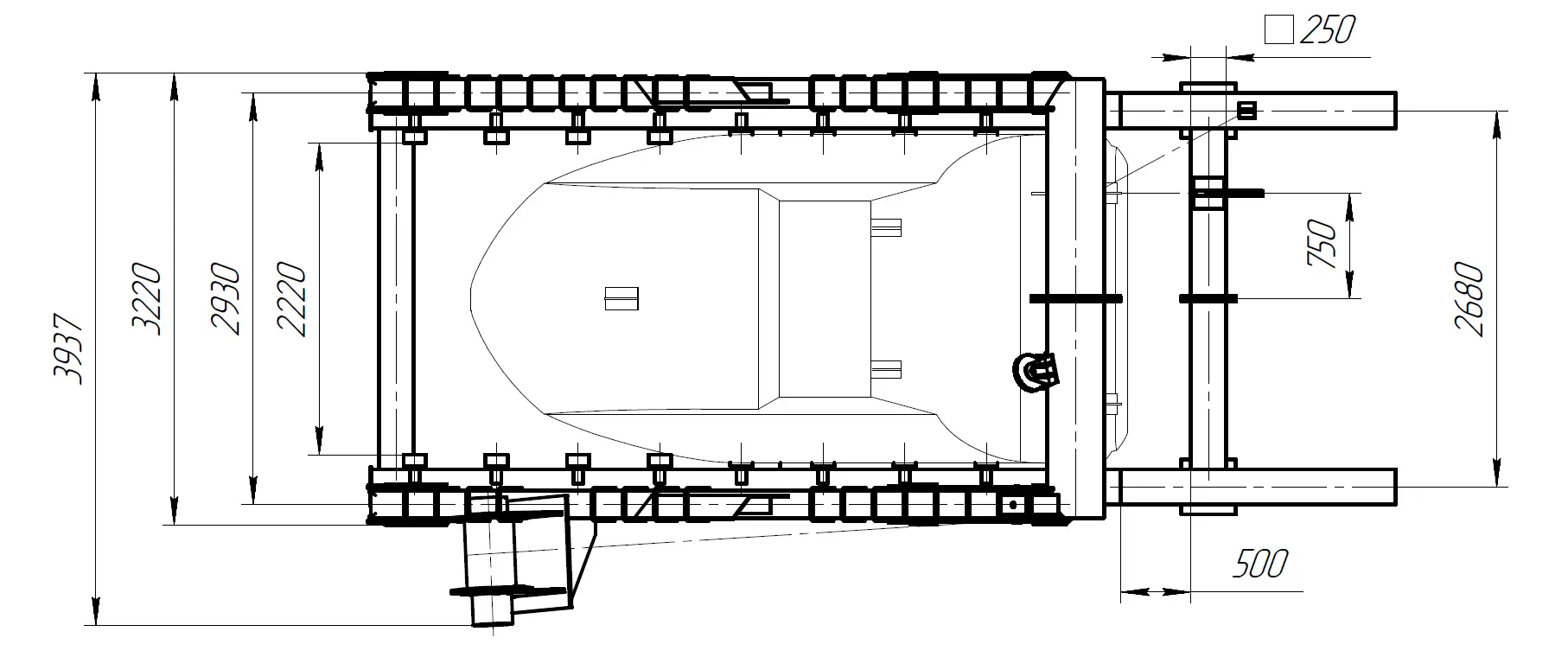
| Frame length | 7245 mm |
| Frame width | 2930 mm |
| Boom length | 7782 mm |
The equipment complies with the following requirements:
Related
Personal Data Processing Policy
1. General provisions
This Personal data processing Policy is compiled in accordance with the requirements of Federal Law No. 152-FZ dated 27.07.2006 “On Personal Data” (hereinafter referred to as the Personal Data Law) and defines the procedure for processing personal data and measures to ensure the security of personal data taken by Izhora Hydrosystems Co. Ltd (hereinafter referred to as the Operator).
1.1. The Operator sets as its most important goal and condition for the implementation of its activities the observance of the rights and freedoms of man and citizen in the processing of his personal data, including the protection of the rights to privacy, personal and family secrets.
1.2. This Operator’s policy regarding the processing of personal data (hereinafter referred to as the Policy) applies to all information that the Operator can receive about website visitors https://i-hydro.ru .
2. Basic concepts used in the Policy
2.1. Automated processing of personal data — processing of personal data using computer technology.
2.2. Blocking of personal data — temporary termination of processing of personal data (except in cases where processing is necessary to clarify personal data).
2.3. Website – a set of graphic and informational materials, as well as computer programs and databases that ensure their availability on the Internet at a network address https://i-hydro.ru .
2.4. Personal data information system — a set of personal data contained in databases and information technologies and technical means that ensure their processing.
2.5. Depersonalization of personal data — actions as a result of which it is impossible to determine, without the use of additional information, the identity of personal data to a specific User or other subject of personal data.
2.6. Personal data processing — any action (operation) or set of actions (operations) performed with or without the use of automation tools with personal data, including collection, recording, systematization, accumulation, storage, clarification (updating, modification), extraction, use, transfer (distribution, provision, access), depersonalization, blocking, deletion, destruction of personal data.
2.7. Operator — a state body, municipal body, legal entity or individual, independently or jointly with other persons organizing and /or processing personal data, as well as determining the purposes of processing personal data, the composition of personal data to be processed, actions (operations) performed with personal data.
2.8. Personal data — any information related directly or indirectly to a specific or identifiable User of the Website https://i-hydro.ru .
2.9. Personal data authorized by the subject of personal data for distribution — personal data to which an unlimited number of persons have access by the subject of personal data by giving consent to the processing of personal data authorized by the subject of personal data for distribution in accordance with the procedure provided for by the Law on Personal Data (hereinafter — personal data authorized for distribution).
2.10. User — any visitor to the website https://i-hydro.ru .
2.11. Provision of personal data — actions aimed at disclosure of personal data to a certain person or a certain circle of persons.
2.12. Dissemination of personal data — any actions aimed at disclosure of personal data to an indefinite circle of persons (transfer of personal data) or familiarization with personal data of an unlimited circle of persons, including the publication of personal data in the media, placement in information and telecommunications networks or providing access to personal data in any other way.
2.13. Cross—border transfer of personal data is the transfer of personal data to the territory of a foreign state to the authority of a foreign state, a foreign individual or a foreign legal entity.
2.14. Destruction of personal data — any actions as a result of which personal data is permanently destroyed with the impossibility of further restoration of the content of personal data in the personal data information system and/or the material carriers of personal data are destroyed.
3. Basic rights and obligations of the Operator
3.1. The Operator has the right to:
— receive reliable information and/or documents containing personal data from the subject of personal data;
— if the personal data subject withdraws consent to the processing of personal data, as well as sending a request to terminate the processing of personal data, the Operator has the right to continue processing personal data without the consent of the personal data subject if there are grounds specified in the Law on Personal Data;
— independently determine the composition and list of measures necessary and sufficient to ensure the fulfillment of obligations provided for by the Law on Personal Data and regulatory legal acts adopted in accordance with it, unless otherwise provided by the Law on Personal Data or other federal laws.
3.2. The Operator is obliged to:
— to provide the subject of personal data, at his request, with information concerning the processing of his personal data;
— organize the processing of personal data in accordance with the procedure established by the current legislation of the Russian Federation;
— respond to requests and requests from personal data subjects and their legal representatives in accordance with the requirements of the Personal Data Law;
— to inform the authorized body for the protection of the rights of personal data subjects at the request of this body of the necessary information within 10 days from the date of receipt of such a request;
— publish or otherwise provide unrestricted access to this Policy regarding the processing of personal data;
— take legal, organizational and technical measures to protect personal data from unauthorized or accidental access to them, destruction, modification, blocking, copying, provision, dissemination of personal data, as well as from other illegal actions with respect to personal data;
— stop the transfer (distribution, provision, access) of personal data, stop processing and destroy personal data in the manner and cases provided for by the Law on Personal Data;
— perform other duties provided for by the Law on Personal Data.
4. Basic rights and obligations of personal data subjects
4.1. Personal data subjects have the right to:
— receive information concerning the processing of his personal data, except in cases provided for by federal laws. The information is provided to the personal data subject by the Operator in an accessible form, and it should not contain personal data related to other personal data subjects, except in cases where there are legitimate grounds for disclosure of such personal data. The list of information and the procedure for obtaining it is established by the Law on Personal Data;
— require the operator to clarify his personal data, block or destroy them if the personal data are incomplete, outdated, inaccurate, illegally obtained or are not necessary for the stated purpose of processing, as well as take measures provided by law to protect their rights;
— to put forward a condition of prior consent when processing personal data in order to promote goods, works and services on the market;
— to revoke consent to the processing of personal data, as well as to send a request to terminate the processing of personal data;
— appeal to the authorized body for the protection of the rights of personal data subjects or in court against illegal actions or inaction of the Operator when processing his personal data;
— to exercise other rights provided for by the legislation of the Russian Federation.
4.2. Personal data subjects are obliged to:
— provide the Operator with reliable data about themselves;
— inform the Operator about the clarification (update, change) of their personal data.
4.3. Persons who have provided the Operator with false information about themselves or information about another personal data subject without the latter’s consent are liable in accordance with the legislation of the Russian Federation.
5. Principles of personal data processing
5.1. The processing of personal data is carried out on a legal and fair basis.
5.2. The processing of personal data is limited to the achievement of specific, predetermined and legitimate goals. Processing of personal data incompatible with the purposes of personal data collection is not allowed.
5.3. It is not allowed to combine databases containing personal data, the processing of which is carried out for purposes incompatible with each other.
5.4. Only personal data that meet the purposes of their processing are subject to processing.
5.5. The content and volume of the processed personal data correspond to the stated purposes of processing. Redundancy of the processed personal data in relation to the stated purposes of their processing is not allowed.
5.6. When processing personal data, the accuracy of personal data, their sufficiency, and, if necessary, relevance to the purposes of personal data processing is ensured. The Operator takes the necessary measures and/or ensures that they are taken to delete or clarify incomplete or inaccurate data.
5.7. The storage of personal data is carried out in a form that allows determining the subject of personal data, no longer than the purposes of personal data processing require, unless the storage period of personal data is established by federal law, an agreement to which the subject of personal data is a party, beneficiary or guarantor. The processed personal data is destroyed or depersonalized upon achievement of the processing goals or in case of loss of the need to achieve these goals, unless otherwise provided by federal law.
| Purpose of processing | Informing the User by means of voice communication and e-mail |
|---|---|
| Personal data |
|
| Legal grounds |
|
| Types of personal data processing |
|
7. Terms of personal data processing
7.1. The processing of personal data is carried out with the consent of the personal data subject to the processing of his personal data.
7.2. The processing of personal data is necessary to achieve the goals stipulated by an international agreement of the Russian Federation or a law, to carry out the functions, powers and duties assigned to the operator by the legislation of the Russian Federation.
7.3. The processing of personal data is necessary for the administration of justice, the execution of a judicial act, an act of another body or official subject to execution in accordance with the legislation of the Russian Federation on enforcement proceedings.
7.4. The processing of personal data is necessary for the execution of a contract to which the personal data subject is a party or beneficiary or guarantor, as well as for the conclusion of a contract on the initiative of the personal data subject or a contract under which the personal data subject will be a beneficiary or guarantor.
7.5. The processing of personal data is necessary to exercise the rights and legitimate interests of the operator or third parties or to achieve socially significant goals, provided that the rights and freedoms of the personal data subject are not violated.
7.6. Personal data is processed, access to which is granted to an unlimited number of persons by the subject of personal data or at his request (hereinafter referred to as publicly available personal data).
7.7. Personal data subject to publication or mandatory disclosure in accordance with federal law is processed.8. Procedure for the collection, storage, transfer and other types of personal data processing
The security of personal data processed by the Operator is ensured through the implementation of legal, organizational and technical measures necessary to fully comply with the requirements of current legislation in the field of personal data protection.
8. Procedure for the collection, storage, transfer and other types of personal data processing
The security of personal data processed by the Operator is ensured through the implementation of legal, organizational and technical measures necessary to fully comply with the requirements of current legislation in the field of personal data protection.
8.1. The Operator ensures the safety of personal data and takes all possible measures to exclude access to the personal data of unauthorized persons.
8.2. The User’s personal data will never, under any circumstances, be transferred to third parties, except in cases related to the implementation of current legislation or if the subject of personal data has given consent to the Operator to transfer data to a third party to fulfill obligations under a civil contract.
8.3. In case of inaccuracies in personal data, the User can update them independently by sending a notification to the Operator to the Operator’s email address
contact@i-hydro.ru
8.4. The period of processing of personal data is determined by the achievement of the purposes for which personal data was collected, unless another period is provided for by the contract or current legislation..
The User can withdraw his consent to the processing of personal data at any time by sending a notification to the Operator via e-mail to the Operator’s e-mail address contact@i-hydro.ru marked “Withdrawal of consent to the processing of personal data”.
8.5. All information collected by third-party services, including payment systems, means of communication and other service providers, is stored and processed by these persons (Operators) in accordance with their User Agreement and Privacy Policy. The subject of personal data and/or with the specified documents. The Operator is not responsible for the actions of third parties, including the service providers specified in this paragraph.
8.6. The prohibitions established by the subject of personal data on the transfer (except for granting access), as well as on the processing or processing conditions (except for obtaining access) of personal data permitted for distribution, do not apply in cases of processing of personal data in the state, public and other public interests defined by the legislation of the Russian Federation.
8.7. When processing personal data, the Operator ensures the confidentiality of personal data.
8.8. The Operator stores personal data in a form that allows determining the subject of personal data, no longer than the purposes of personal data processing require, unless the period of personal data storage is established by federal law, an agreement to which the subject of personal data is a party, beneficiary or guarantor.
8.9. The condition for the termination of personal data processing may be the achievement of the purposes of personal data processing, the expiration of the consent of the personal data subject, the withdrawal of consent by the personal data subject or the requirement to terminate the processing of personal data, as well as the identification of unlawful processing of personal data.
9. List of actions performed by the Operator with the received personal data
9.1. The Operator collects, records, systematizes, accumulates, stores, clarifies (updates, changes), extracts, uses, transfers (distribution, provision, access), depersonalizes, blocks, deletes and destroys personal data.
9.2. The Operator performs automated processing of personal data with or without receiving and/or transmitting the received information via information and telecommunication networks.
10. Cross-border transfer of personal data
10.1. Prior to the start of cross-border transfer of personal data, the Operator is obliged to notify the authorized body for the protection of the rights of personal data subjects of its intention to carry out cross-border transfer of personal data (such notification is sent separately from the notification of the intention to process personal data).
10.2. Before submitting the above notification, the Operator is obliged to receive relevant information from the authorities of a foreign state, foreign individuals, foreign legal entities to whom the cross-border transfer of personal data is planned.
11. Confidentiality of personal data
The operator and other persons who have gained access to personal data are obliged not to disclose to third parties and not to distribute personal data without the consent of the subject of personal data, unless otherwise provided by federal law.
12. Final provisions
12.1. The User can receive any clarifications on issues of interest concerning the processing of his personal data by contacting the Operator via e-mail
contact@i-hydro.ru
12.2. This document will reflect any changes to the personal data processing policy by the Operator. The policy is valid indefinitely until it is replaced by a new version.
12.3. The current version of the Policy is freely available on the Internet at https://i-hydro.ru .