Navigation
Related
We offer custom-designed watertight and spraytight hydraulic hatch covers with dimensions up to 13×13 m. This integrated system solution addresses multiple operational needs simultaneously, ensuring reliable protection and stable performance in all conditions.
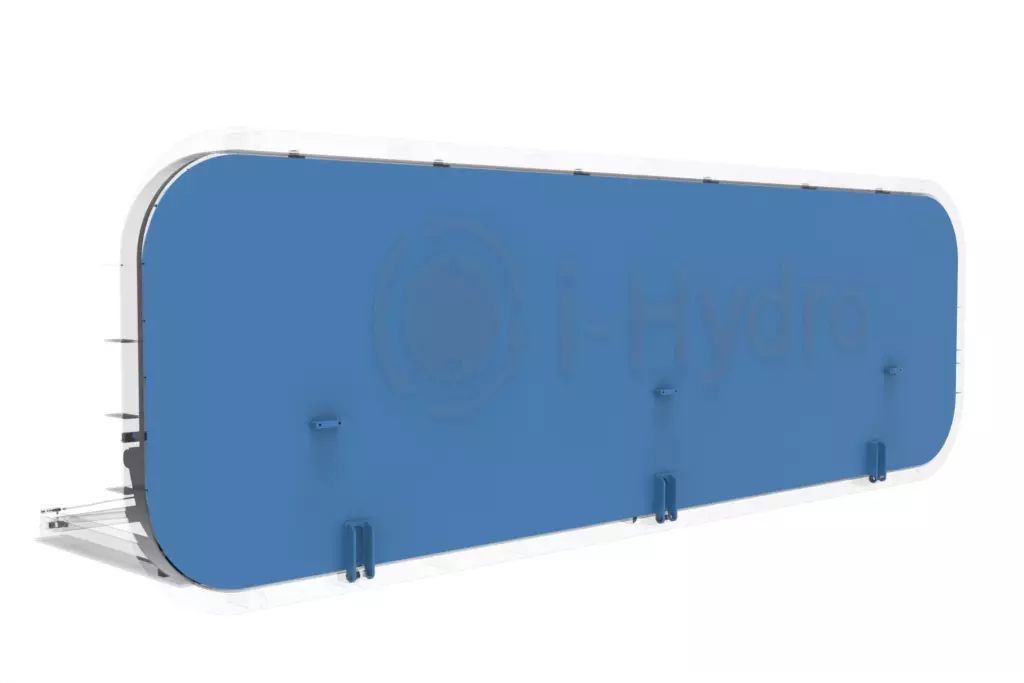
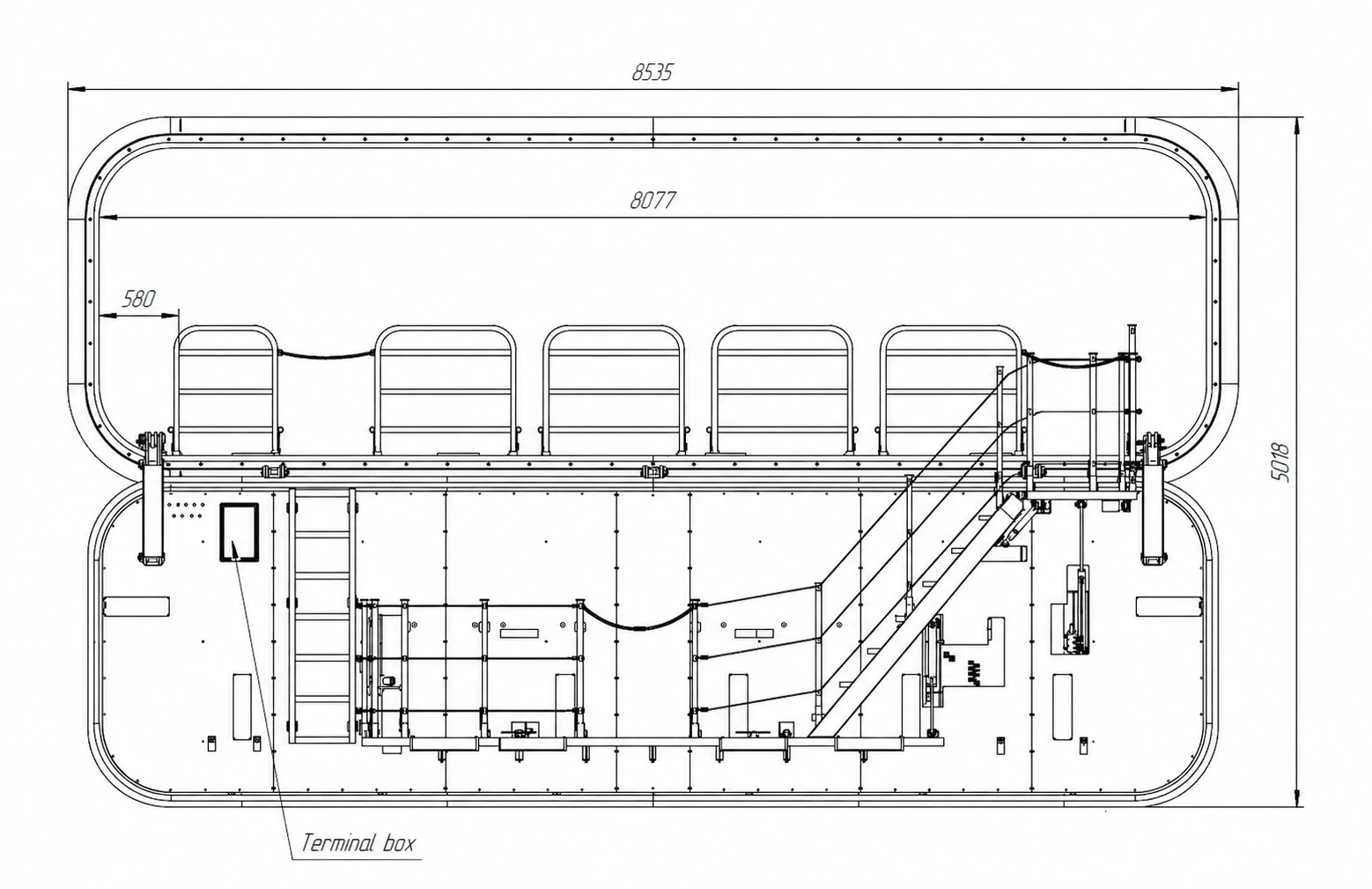
Model 8.5×2.5M is a rectangular single-leaf side shell door featuring a built-in boarding ladder and stairs for water access. Its design ensures secure integration into the ship’s hull and includes removable railings that can be easily installed by personnel to guarantee passenger safety.
Loading model

(highlighted in blue)
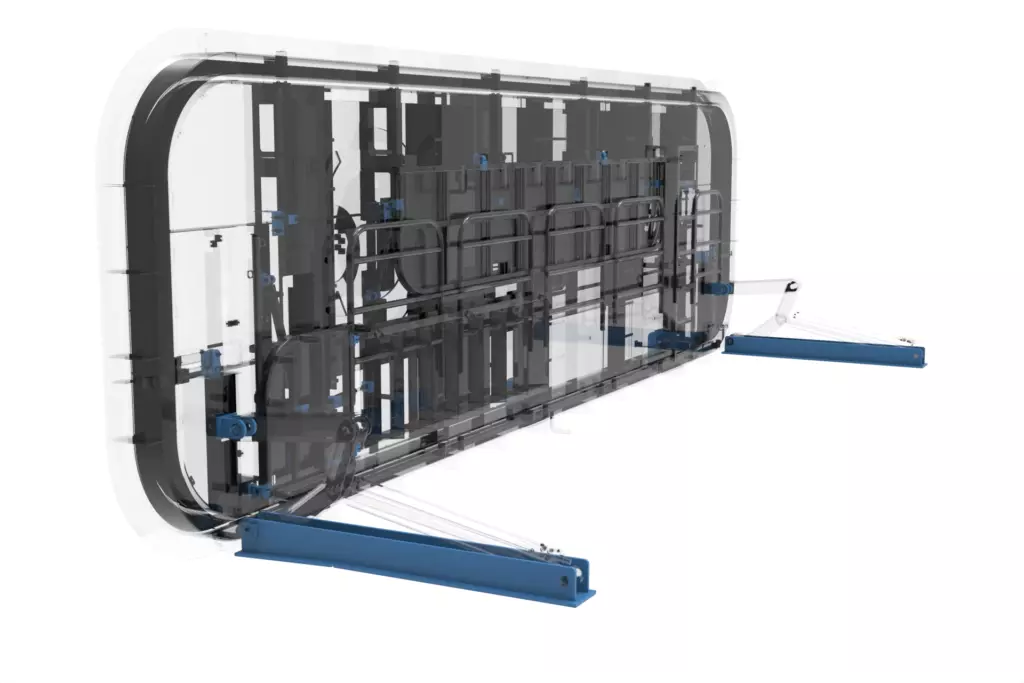
The coaming is a welded structure integrated into the ship’s opening with an overlap hull connection. Welded lugs at the bottom ensure secure attachment of the closure.
(highlighted in blue)
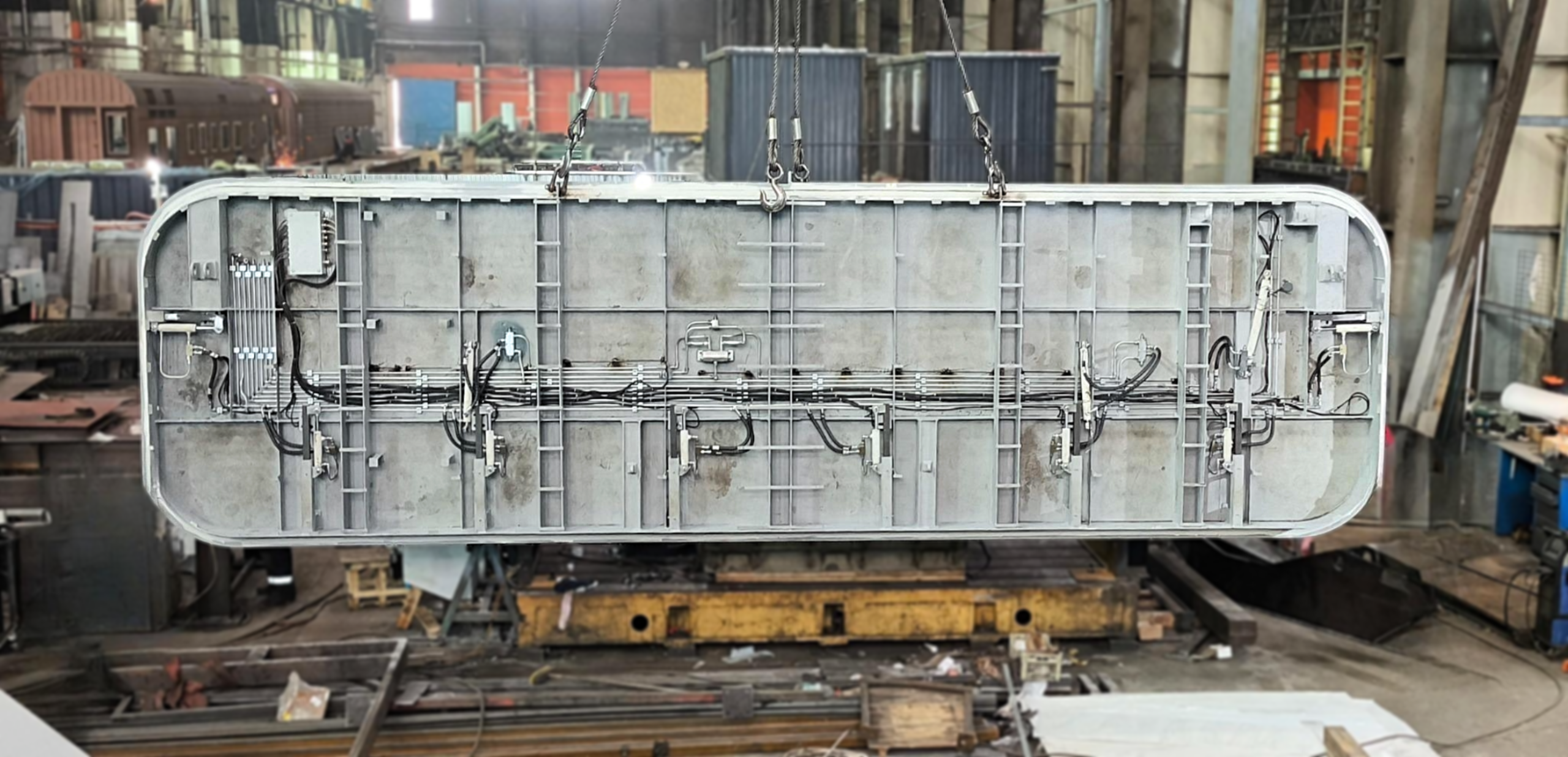
The door leaf is a robust welded frame structure with decorative steel plating. The upper section is equipped with welded lugs for secure attachment to the coaming. The plating ensures a gas-tight and watertight seal, guaranteeing stable and long-lasting operation.
(highlighted in blue)
The brackets are a welded structure designed for hydraulic cylinder mounting. Installed within the ship’s deck, they ensure reliable operation under loads from the door leaf weight and personnel using the ladder.
(highlighted in blue)
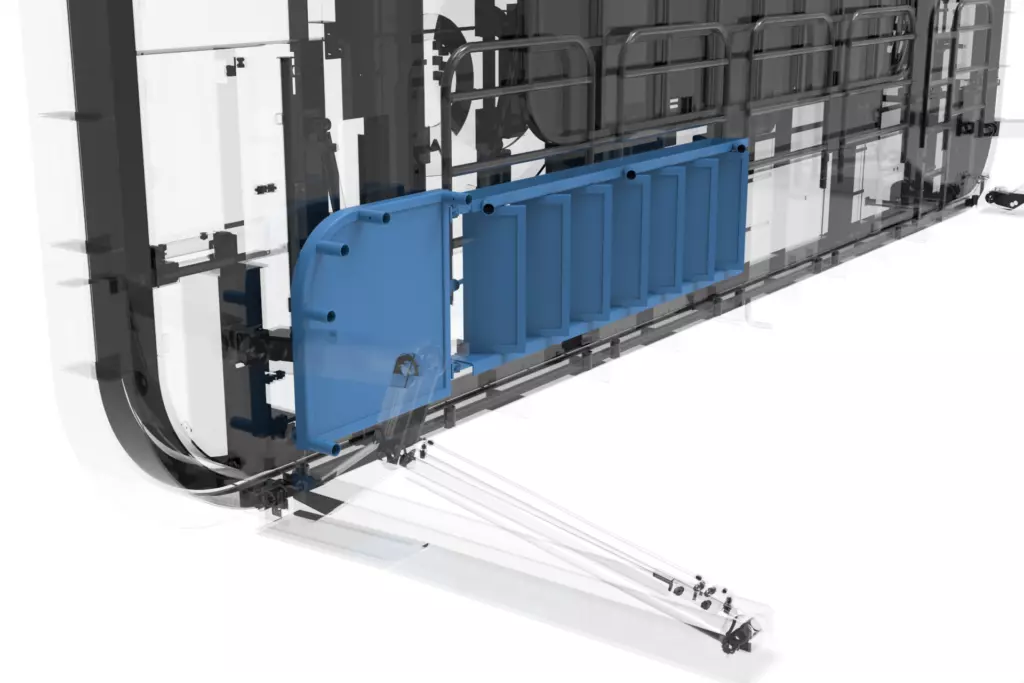
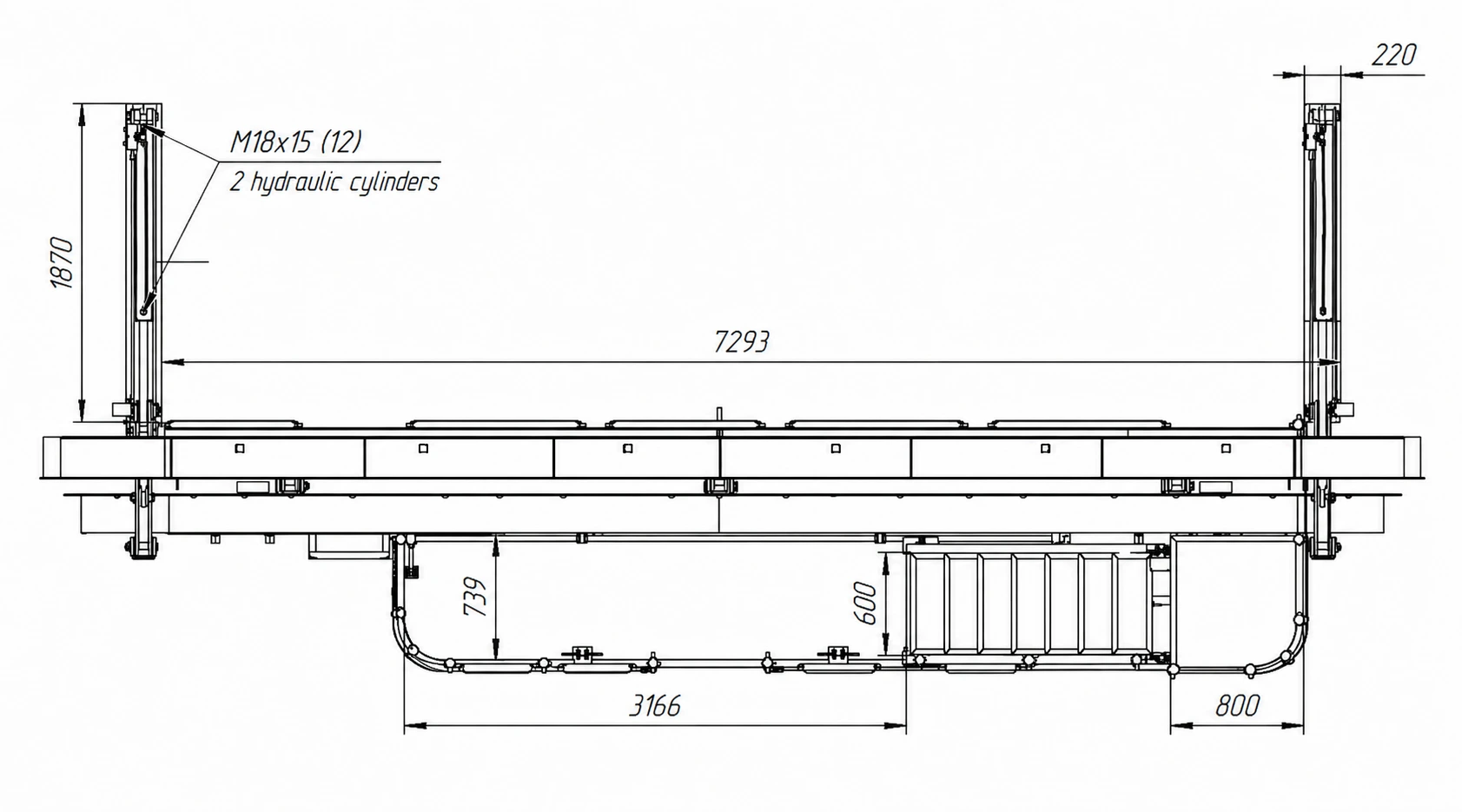
The ladder assembly is a flight of stairs attached to the upper landing platform via welded lugs. The design allows the ladder to be folded parallel to the platform using a hydraulic cylinder and mechanically locked in the lowered position. Welded sockets enable quick attachment of the removable guard rails for safe use.
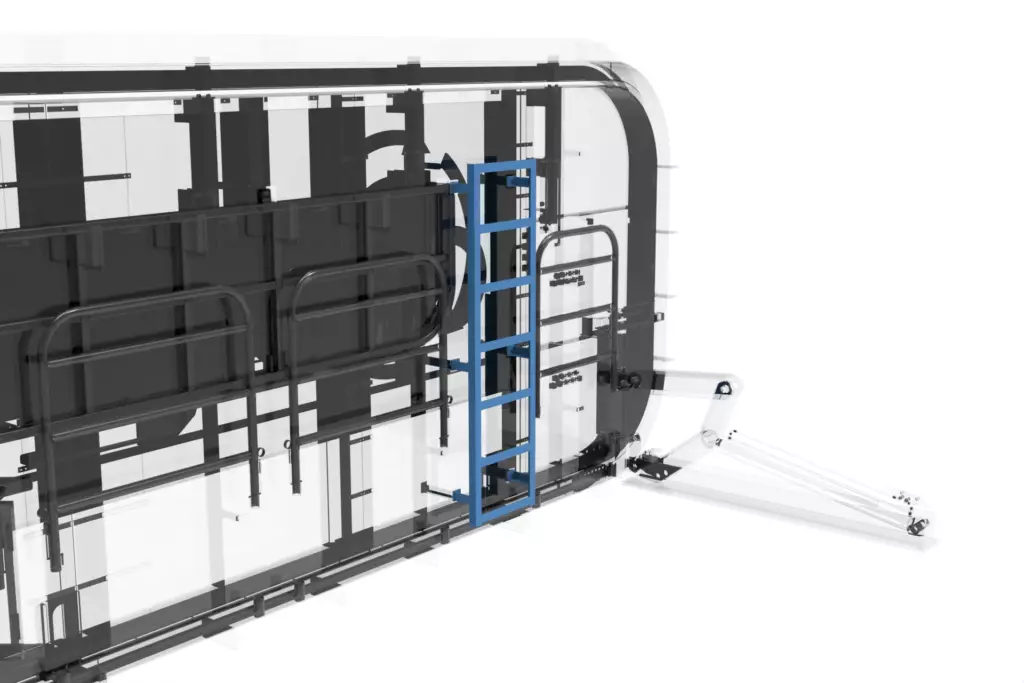
(highlighted in blue)
The emergency ladder is a stationary ladder fixed to the side shell door for emergency egress. Secure attachment is provided via welded brackets and bolted connections, ensuring constant readiness for use in an emergency situation.
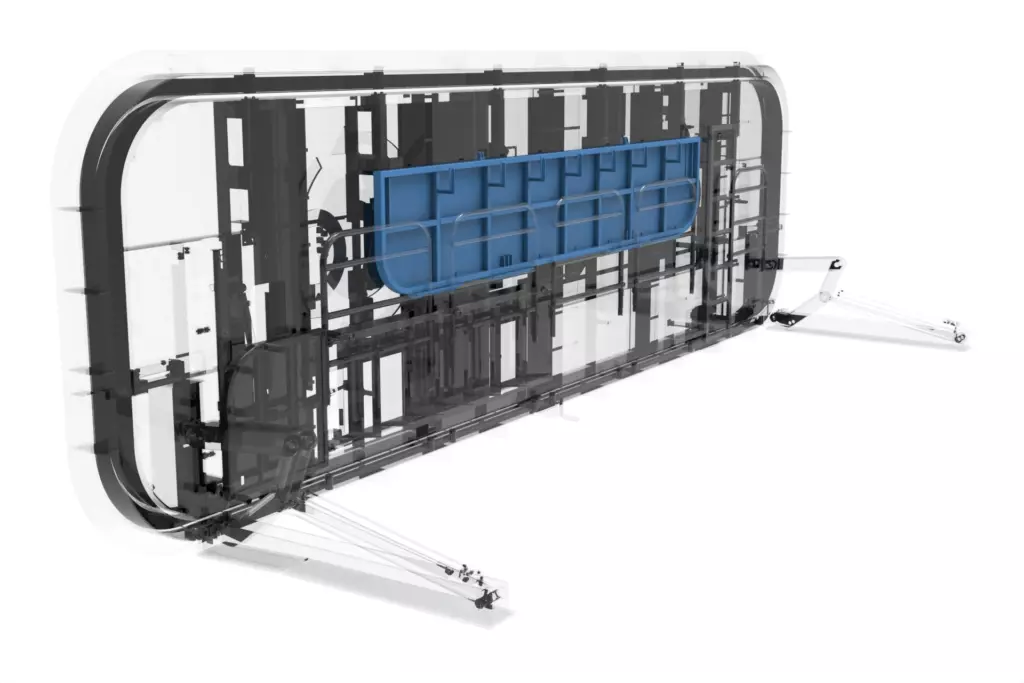
(highlighted in blue)
The lower landing platform is a reinforced welded structure designed to accommodate two people simultaneously. Hydraulic cylinders enable the platform to fold into the plane of the side shell door for compactness. The upper section features welded lugs for secure attachment to the door, while the perimeter is equipped with fenders for impact protection and cleats for mooring. Welded sockets allow for quick installation of guard rails, ensuring safe operation.
The following documentation provided with the unit:
| Document | Quantity |
|---|---|
| Product Data Sheet | 1 |
| Installation, Commissioning, and Adjustment Manual | 1 |
| Operating Manual | 1 |
| Onboard Test Program and Methodology | 1 |
| Declaration of Materials (DM) | 1 |
| Supplier’s Declaration of Conformity (SDoC) | 1 |
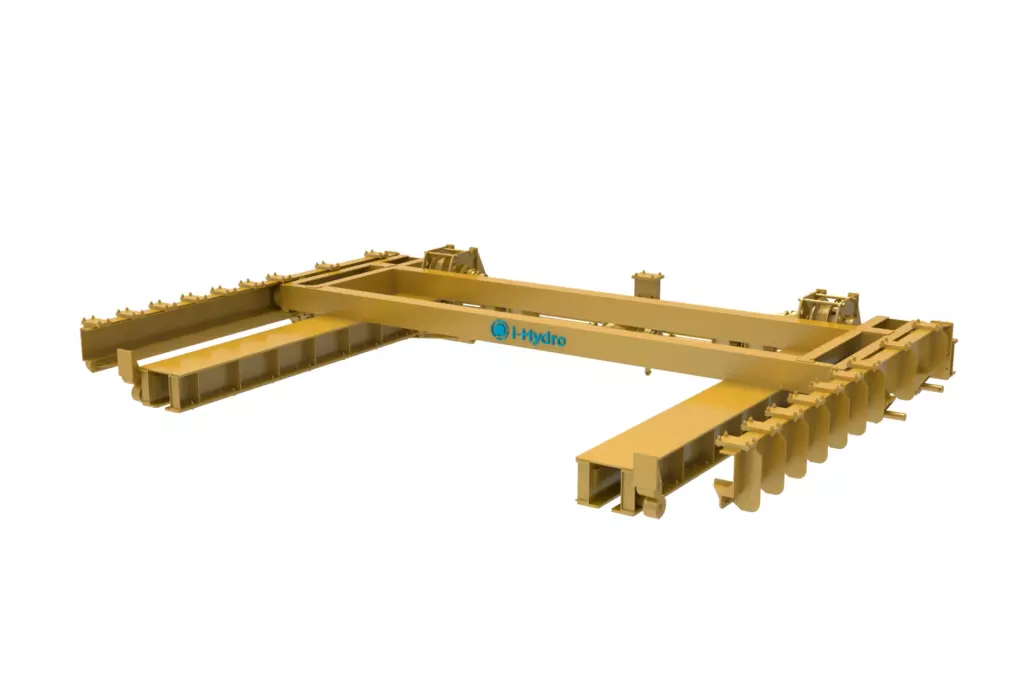
This multifunctional closure is available both as a standalone unit and as part of a complete package with our LARS systems.
The following launch and recovery systems (LARS) are available for delivery with this closure:
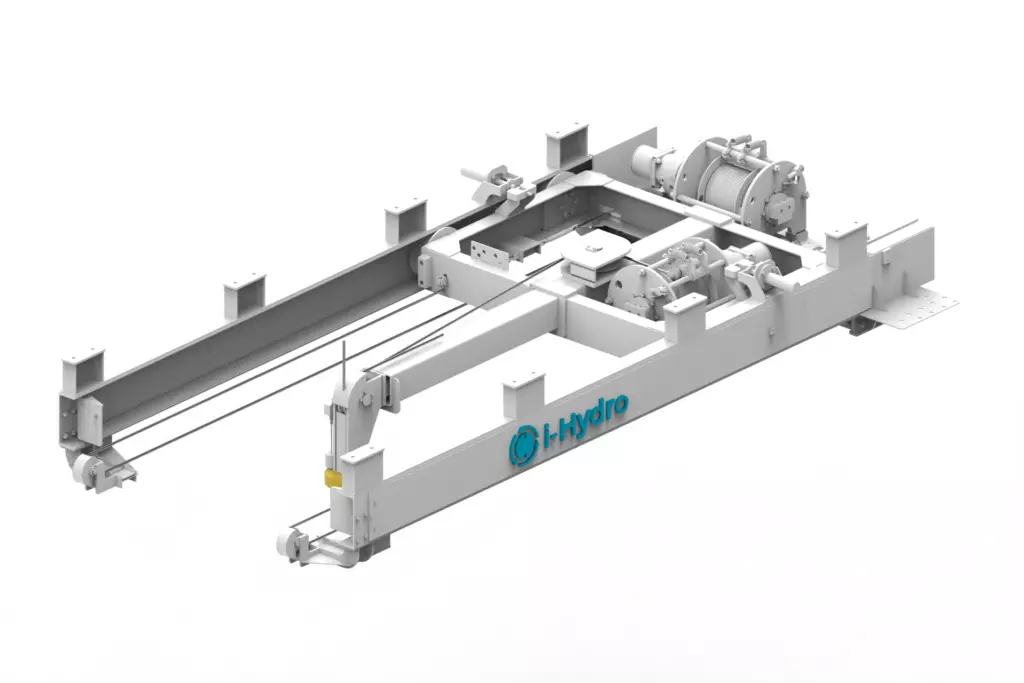
Single-beam telescopic LARS for boats or jet skis weighing up to 650 kg. It allows the vessel to be extended 1.4 m from the hull at a full outreach of 2.6 m. Overhead mounting at a height of 2 m or more ensures safe operation, while an electric winch with a wire rope system guarantees precise and smooth trolley movement.
How a Ship Opens its Hull: A Hydraulic Porch for Ocean-Going Vessels
Imagine a massive ocean liner or a research vessel. The ship’s side is an impenetrable wall as high as a multi-story building. But what if a small yacht or tender moors alongside, and you need to board passengers or load cargo? You can’t simply jump from the deck. This is exactly why sophisticated engineering solutions exist—side shell doors that transform a solid wall into a convenient multi-level boarding porch.
Engineering Marathon: 5.7 Tons of Steel vs. the Elements
The developed device is not just a “door” in the hull, but a true hydraulic transformer. Its total mass is nearly 5.7 tons, and the dimensions of the opening it seals are impressive: over 8 meters high and 2.2 meters wide (8077×2231 mm, to be precise). Mounted in the aft section on the starboard side, the structure must not only withstand water pressure but also provide safe passage for personnel. Why is this so complex? Because the mechanism must operate for years in salt water, extreme temperature fluctuations, and constant ship motion.
What is it made of? The Secret of Durability
To ensure the structure survives harsh marine environments, engineers selected high-reliability materials. The main load-bearing section is welded from 09G2S steel—a special alloy known for its excellent weldability and resistance to cold embrittlement. Steel thicknesses range from 6 to 16 mm, providing a true “armored” safety margin. For the platforms and the lightweight ladder, D16 aluminum alloy was used to avoid overstressing the structure. Lightweight yet durable—much like in aviation—this alloy is used for the guard rails and handrails, which stand exactly 1000 mm high to ensure even a tall person feels secure.
The Folding “Sandwich”: How the Structure Works
Imagine a nesting doll or a folding knife. In the stowed (“closed”) position, the entire structure forms part of the side shell, integrated seamlessly into the ship’s lines. But when the vessel moors, the hydraulic magic begins.
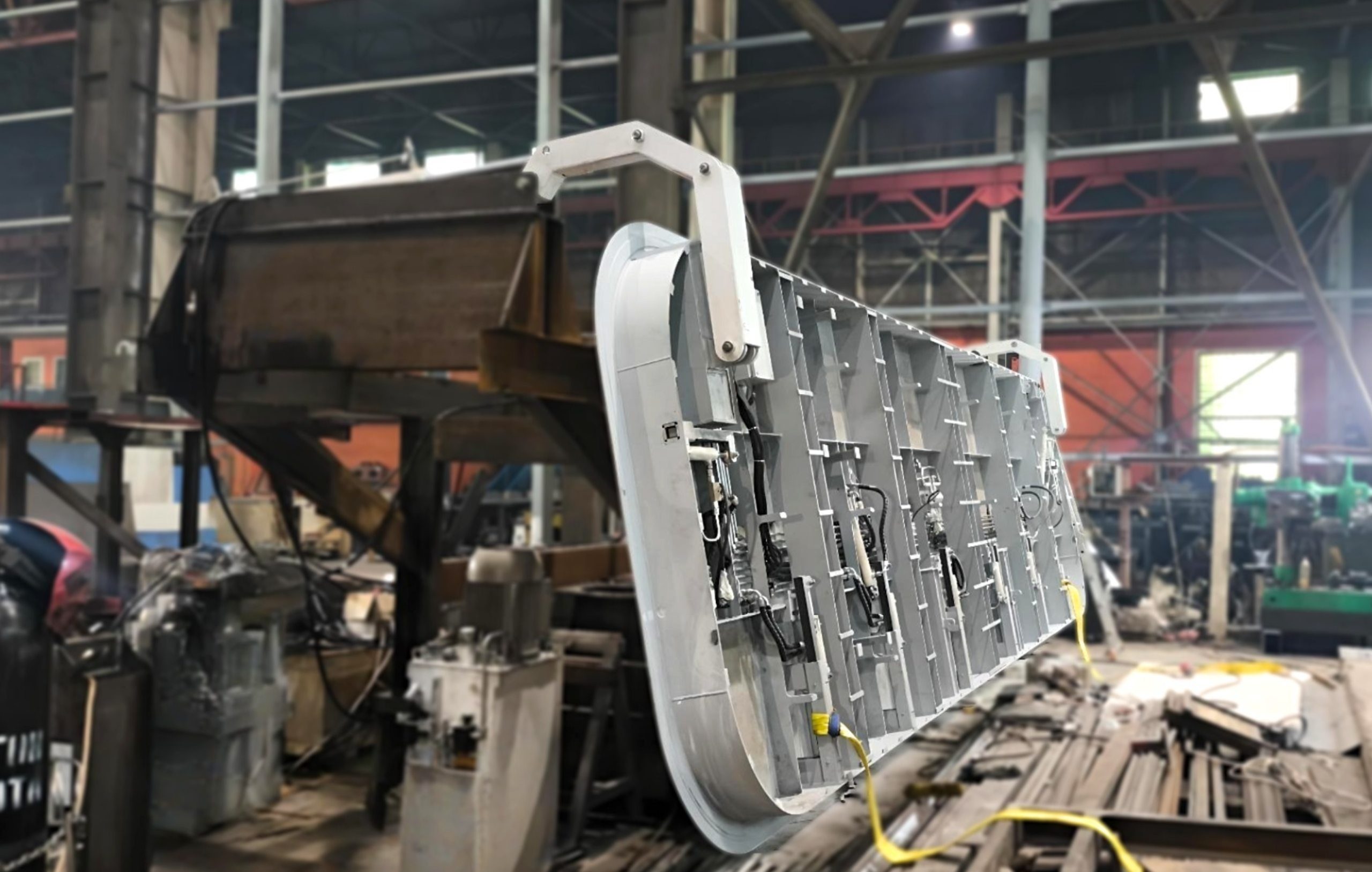
It all starts with the coaming—a heavy-duty steel frame permanently welded into the ship’s hull. The door leaf itself—a large steel “cover” with decorative plating—is attached to this frame via robust lugs. This leaf is what seals the opening. But that is only the first layer.
The Landing Platform: A Porch Above the Water
A landing platform is mounted on the inner side of the door. When stowed, it stays flush within the plane of the hull, but upon opening, it lowers into a horizontal position. It is equipped with its own hydraulic cylinder, acting as a powerful actuator. To prevent anyone from falling overboard, quick-detachable guard rails—stanchions with tensioned wire ropes—are inserted into special sockets along the edges of the platform.
Ladder to the Water: The Hydraulic Boarding Ladder
From the upper platform, you need to descend closer to the water. For this, a complete ladder assembly is provided—a full-scale flight of stairs. Its key feature is that it also folds. Imagine pulling down a folding attic ladder, only here it is raised and lowered by hydraulics. The ladder is attached to the upper platform and, in its working position, rests against the lower platform, where it is mechanically locked to prevent movement caused by waves.
The Final Stretch: The Lower Landing Platform
The most interesting element is the lower landing platform. It is designed to accommodate two people who assist in mooring the tender. This platform is also extended from the hull by hydraulic cylinders. But it has a secret: the perimeter is equipped with fenders (specialized cushions) to ensure the tender doesn’t scratch the vessel’s expensive paintwork during mooring. For secure vessel attachment, it features mooring cleats—metal horns used to fasten the lines.
Plan B: Emergency Egress
Engineers always account for unforeseen circumstances. Should the hydraulics fail during an evacuation, an emergency ladder is fixed to the side shell door. This is a stationary, bolt-mounted ladder that does not fold, ensuring it is always ready for manual descent.
Control System: Complexity Made Simple
From a mechanical perspective, the system has two primary positions: “Open” and “Closed.”
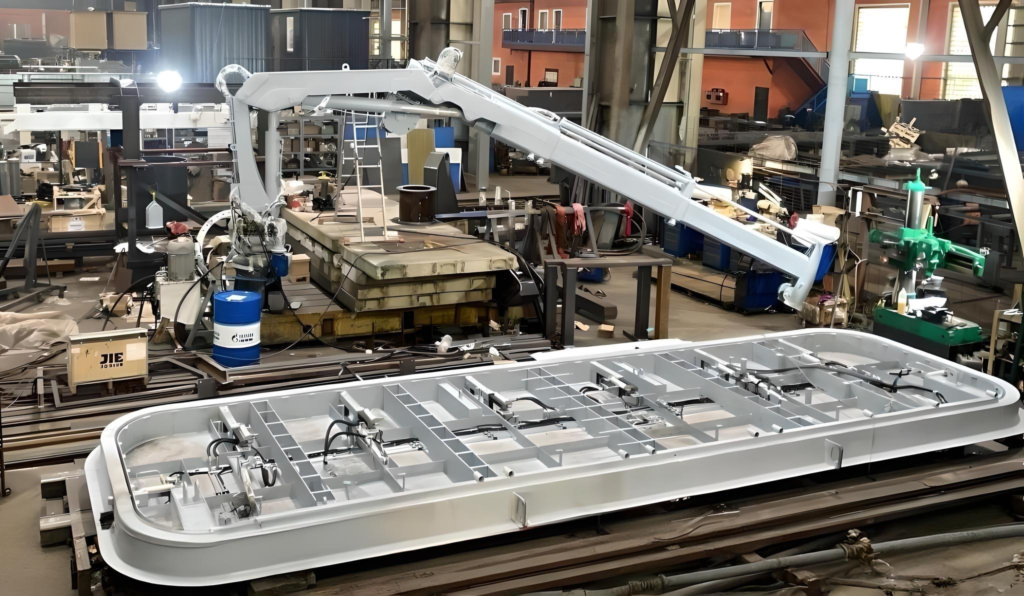
This remarkable combination of traditional shipbuilding steel, aerospace alloys, and modern hydraulics transforms the formidable hull of an ocean-going vessel into a welcoming porch right at the water’s edge.
| Parameter | Value |
|---|---|
| Door leaf mass, kg | 5700 kg |
| Clear opening size, mm | 8077 x 2231 mm |
| Guard rail and handrail height, mm | 1000 mm |
| Removable sectional guard rail height, mm | 1000 mm |
The equipment complies with the following requirements:
Related
Personal Data Processing Policy
1. General provisions
This Personal data processing Policy is compiled in accordance with the requirements of Federal Law No. 152-FZ dated 27.07.2006 “On Personal Data” (hereinafter referred to as the Personal Data Law) and defines the procedure for processing personal data and measures to ensure the security of personal data taken by Izhora Hydrosystems Co. Ltd (hereinafter referred to as the Operator).
1.1. The Operator sets as its most important goal and condition for the implementation of its activities the observance of the rights and freedoms of man and citizen in the processing of his personal data, including the protection of the rights to privacy, personal and family secrets.
1.2. This Operator’s policy regarding the processing of personal data (hereinafter referred to as the Policy) applies to all information that the Operator can receive about website visitors https://i-hydro.ru .
2. Basic concepts used in the Policy
2.1. Automated processing of personal data — processing of personal data using computer technology.
2.2. Blocking of personal data — temporary termination of processing of personal data (except in cases where processing is necessary to clarify personal data).
2.3. Website – a set of graphic and informational materials, as well as computer programs and databases that ensure their availability on the Internet at a network address https://i-hydro.ru .
2.4. Personal data information system — a set of personal data contained in databases and information technologies and technical means that ensure their processing.
2.5. Depersonalization of personal data — actions as a result of which it is impossible to determine, without the use of additional information, the identity of personal data to a specific User or other subject of personal data.
2.6. Personal data processing — any action (operation) or set of actions (operations) performed with or without the use of automation tools with personal data, including collection, recording, systematization, accumulation, storage, clarification (updating, modification), extraction, use, transfer (distribution, provision, access), depersonalization, blocking, deletion, destruction of personal data.
2.7. Operator — a state body, municipal body, legal entity or individual, independently or jointly with other persons organizing and /or processing personal data, as well as determining the purposes of processing personal data, the composition of personal data to be processed, actions (operations) performed with personal data.
2.8. Personal data — any information related directly or indirectly to a specific or identifiable User of the Website https://i-hydro.ru .
2.9. Personal data authorized by the subject of personal data for distribution — personal data to which an unlimited number of persons have access by the subject of personal data by giving consent to the processing of personal data authorized by the subject of personal data for distribution in accordance with the procedure provided for by the Law on Personal Data (hereinafter — personal data authorized for distribution).
2.10. User — any visitor to the website https://i-hydro.ru .
2.11. Provision of personal data — actions aimed at disclosure of personal data to a certain person or a certain circle of persons.
2.12. Dissemination of personal data — any actions aimed at disclosure of personal data to an indefinite circle of persons (transfer of personal data) or familiarization with personal data of an unlimited circle of persons, including the publication of personal data in the media, placement in information and telecommunications networks or providing access to personal data in any other way.
2.13. Cross—border transfer of personal data is the transfer of personal data to the territory of a foreign state to the authority of a foreign state, a foreign individual or a foreign legal entity.
2.14. Destruction of personal data — any actions as a result of which personal data is permanently destroyed with the impossibility of further restoration of the content of personal data in the personal data information system and/or the material carriers of personal data are destroyed.
3. Basic rights and obligations of the Operator
3.1. The Operator has the right to:
— receive reliable information and/or documents containing personal data from the subject of personal data;
— if the personal data subject withdraws consent to the processing of personal data, as well as sending a request to terminate the processing of personal data, the Operator has the right to continue processing personal data without the consent of the personal data subject if there are grounds specified in the Law on Personal Data;
— independently determine the composition and list of measures necessary and sufficient to ensure the fulfillment of obligations provided for by the Law on Personal Data and regulatory legal acts adopted in accordance with it, unless otherwise provided by the Law on Personal Data or other federal laws.
3.2. The Operator is obliged to:
— to provide the subject of personal data, at his request, with information concerning the processing of his personal data;
— organize the processing of personal data in accordance with the procedure established by the current legislation of the Russian Federation;
— respond to requests and requests from personal data subjects and their legal representatives in accordance with the requirements of the Personal Data Law;
— to inform the authorized body for the protection of the rights of personal data subjects at the request of this body of the necessary information within 10 days from the date of receipt of such a request;
— publish or otherwise provide unrestricted access to this Policy regarding the processing of personal data;
— take legal, organizational and technical measures to protect personal data from unauthorized or accidental access to them, destruction, modification, blocking, copying, provision, dissemination of personal data, as well as from other illegal actions with respect to personal data;
— stop the transfer (distribution, provision, access) of personal data, stop processing and destroy personal data in the manner and cases provided for by the Law on Personal Data;
— perform other duties provided for by the Law on Personal Data.
4. Basic rights and obligations of personal data subjects
4.1. Personal data subjects have the right to:
— receive information concerning the processing of his personal data, except in cases provided for by federal laws. The information is provided to the personal data subject by the Operator in an accessible form, and it should not contain personal data related to other personal data subjects, except in cases where there are legitimate grounds for disclosure of such personal data. The list of information and the procedure for obtaining it is established by the Law on Personal Data;
— require the operator to clarify his personal data, block or destroy them if the personal data are incomplete, outdated, inaccurate, illegally obtained or are not necessary for the stated purpose of processing, as well as take measures provided by law to protect their rights;
— to put forward a condition of prior consent when processing personal data in order to promote goods, works and services on the market;
— to revoke consent to the processing of personal data, as well as to send a request to terminate the processing of personal data;
— appeal to the authorized body for the protection of the rights of personal data subjects or in court against illegal actions or inaction of the Operator when processing his personal data;
— to exercise other rights provided for by the legislation of the Russian Federation.
4.2. Personal data subjects are obliged to:
— provide the Operator with reliable data about themselves;
— inform the Operator about the clarification (update, change) of their personal data.
4.3. Persons who have provided the Operator with false information about themselves or information about another personal data subject without the latter’s consent are liable in accordance with the legislation of the Russian Federation.
5. Principles of personal data processing
5.1. The processing of personal data is carried out on a legal and fair basis.
5.2. The processing of personal data is limited to the achievement of specific, predetermined and legitimate goals. Processing of personal data incompatible with the purposes of personal data collection is not allowed.
5.3. It is not allowed to combine databases containing personal data, the processing of which is carried out for purposes incompatible with each other.
5.4. Only personal data that meet the purposes of their processing are subject to processing.
5.5. The content and volume of the processed personal data correspond to the stated purposes of processing. Redundancy of the processed personal data in relation to the stated purposes of their processing is not allowed.
5.6. When processing personal data, the accuracy of personal data, their sufficiency, and, if necessary, relevance to the purposes of personal data processing is ensured. The Operator takes the necessary measures and/or ensures that they are taken to delete or clarify incomplete or inaccurate data.
5.7. The storage of personal data is carried out in a form that allows determining the subject of personal data, no longer than the purposes of personal data processing require, unless the storage period of personal data is established by federal law, an agreement to which the subject of personal data is a party, beneficiary or guarantor. The processed personal data is destroyed or depersonalized upon achievement of the processing goals or in case of loss of the need to achieve these goals, unless otherwise provided by federal law.
| Purpose of processing | Informing the User by means of voice communication and e-mail |
|---|---|
| Personal data |
|
| Legal grounds |
|
| Types of personal data processing |
|
7. Terms of personal data processing
7.1. The processing of personal data is carried out with the consent of the personal data subject to the processing of his personal data.
7.2. The processing of personal data is necessary to achieve the goals stipulated by an international agreement of the Russian Federation or a law, to carry out the functions, powers and duties assigned to the operator by the legislation of the Russian Federation.
7.3. The processing of personal data is necessary for the administration of justice, the execution of a judicial act, an act of another body or official subject to execution in accordance with the legislation of the Russian Federation on enforcement proceedings.
7.4. The processing of personal data is necessary for the execution of a contract to which the personal data subject is a party or beneficiary or guarantor, as well as for the conclusion of a contract on the initiative of the personal data subject or a contract under which the personal data subject will be a beneficiary or guarantor.
7.5. The processing of personal data is necessary to exercise the rights and legitimate interests of the operator or third parties or to achieve socially significant goals, provided that the rights and freedoms of the personal data subject are not violated.
7.6. Personal data is processed, access to which is granted to an unlimited number of persons by the subject of personal data or at his request (hereinafter referred to as publicly available personal data).
7.7. Personal data subject to publication or mandatory disclosure in accordance with federal law is processed.8. Procedure for the collection, storage, transfer and other types of personal data processing
The security of personal data processed by the Operator is ensured through the implementation of legal, organizational and technical measures necessary to fully comply with the requirements of current legislation in the field of personal data protection.
8. Procedure for the collection, storage, transfer and other types of personal data processing
The security of personal data processed by the Operator is ensured through the implementation of legal, organizational and technical measures necessary to fully comply with the requirements of current legislation in the field of personal data protection.
8.1. The Operator ensures the safety of personal data and takes all possible measures to exclude access to the personal data of unauthorized persons.
8.2. The User’s personal data will never, under any circumstances, be transferred to third parties, except in cases related to the implementation of current legislation or if the subject of personal data has given consent to the Operator to transfer data to a third party to fulfill obligations under a civil contract.
8.3. In case of inaccuracies in personal data, the User can update them independently by sending a notification to the Operator to the Operator’s email address
contact@i-hydro.ru
8.4. The period of processing of personal data is determined by the achievement of the purposes for which personal data was collected, unless another period is provided for by the contract or current legislation..
The User can withdraw his consent to the processing of personal data at any time by sending a notification to the Operator via e-mail to the Operator’s e-mail address contact@i-hydro.ru marked “Withdrawal of consent to the processing of personal data”.
8.5. All information collected by third-party services, including payment systems, means of communication and other service providers, is stored and processed by these persons (Operators) in accordance with their User Agreement and Privacy Policy. The subject of personal data and/or with the specified documents. The Operator is not responsible for the actions of third parties, including the service providers specified in this paragraph.
8.6. The prohibitions established by the subject of personal data on the transfer (except for granting access), as well as on the processing or processing conditions (except for obtaining access) of personal data permitted for distribution, do not apply in cases of processing of personal data in the state, public and other public interests defined by the legislation of the Russian Federation.
8.7. When processing personal data, the Operator ensures the confidentiality of personal data.
8.8. The Operator stores personal data in a form that allows determining the subject of personal data, no longer than the purposes of personal data processing require, unless the period of personal data storage is established by federal law, an agreement to which the subject of personal data is a party, beneficiary or guarantor.
8.9. The condition for the termination of personal data processing may be the achievement of the purposes of personal data processing, the expiration of the consent of the personal data subject, the withdrawal of consent by the personal data subject or the requirement to terminate the processing of personal data, as well as the identification of unlawful processing of personal data.
9. List of actions performed by the Operator with the received personal data
9.1. The Operator collects, records, systematizes, accumulates, stores, clarifies (updates, changes), extracts, uses, transfers (distribution, provision, access), depersonalizes, blocks, deletes and destroys personal data.
9.2. The Operator performs automated processing of personal data with or without receiving and/or transmitting the received information via information and telecommunication networks.
10. Cross-border transfer of personal data
10.1. Prior to the start of cross-border transfer of personal data, the Operator is obliged to notify the authorized body for the protection of the rights of personal data subjects of its intention to carry out cross-border transfer of personal data (such notification is sent separately from the notification of the intention to process personal data).
10.2. Before submitting the above notification, the Operator is obliged to receive relevant information from the authorities of a foreign state, foreign individuals, foreign legal entities to whom the cross-border transfer of personal data is planned.
11. Confidentiality of personal data
The operator and other persons who have gained access to personal data are obliged not to disclose to third parties and not to distribute personal data without the consent of the subject of personal data, unless otherwise provided by federal law.
12. Final provisions
12.1. The User can receive any clarifications on issues of interest concerning the processing of his personal data by contacting the Operator via e-mail
contact@i-hydro.ru
12.2. This document will reflect any changes to the personal data processing policy by the Operator. The policy is valid indefinitely until it is replaced by a new version.
12.3. The current version of the Policy is freely available on the Internet at https://i-hydro.ru .